

The recent rain we’ve been getting is certainly a welcome change. Wet weather does, however, present other challenges especially going into the pruning season. That’s right. I’m talking about trunk disease. It’s everywhere, and like viruses, growers like to pretend they don’t have it. After all, it takes years before symptoms express themselves and even longer before they amount to an economic loss. But economic loss from trunk disease is real and, uh, expensive. No one likes being told their best option is tearing out and replanting a vineyard, so let’s go over some ways to be proactive. We’re all stuck in the office right now anyway.
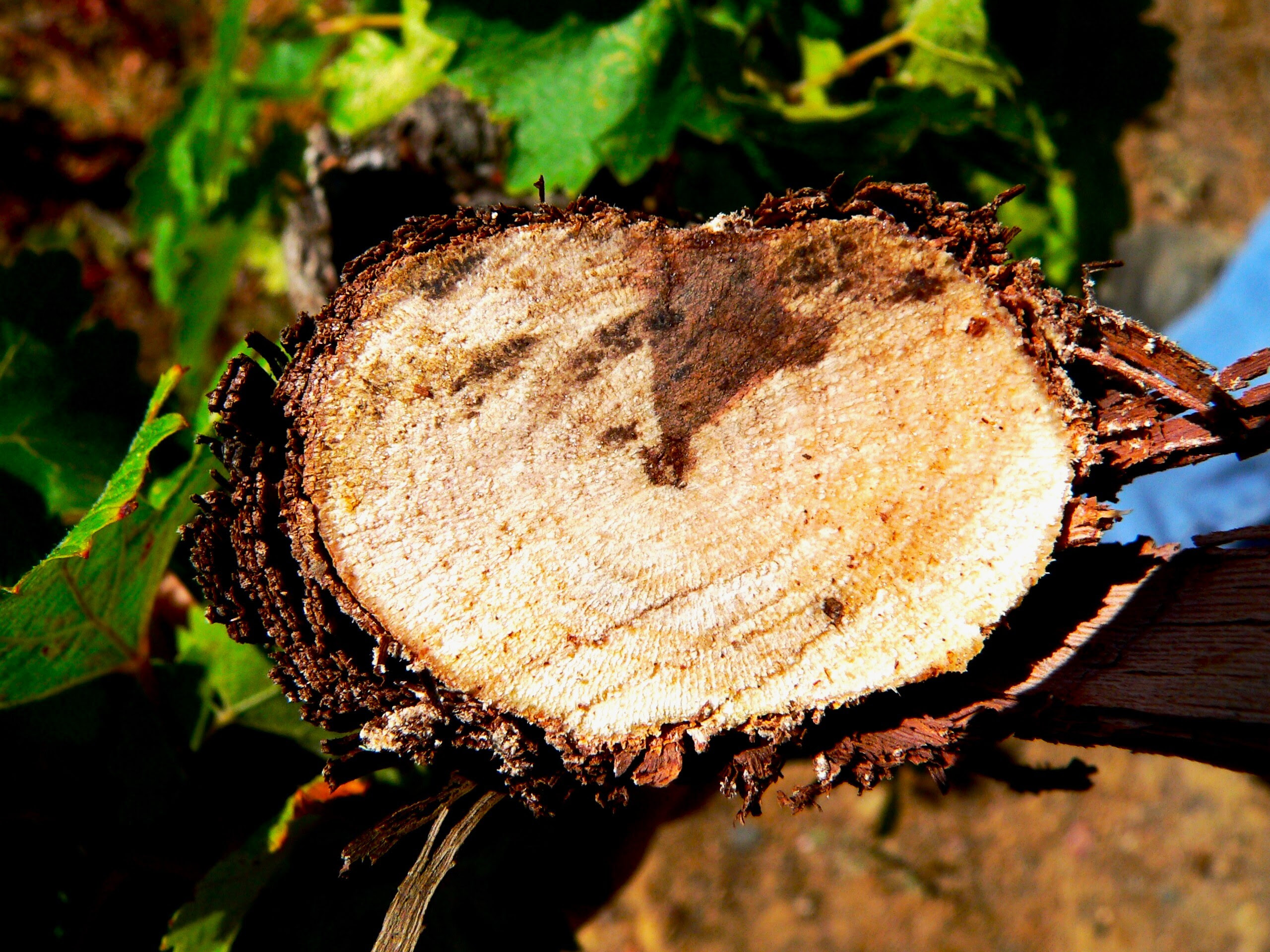 Sometimes there are more than one pathogen present in the vascular tissue. This vine shows the classic wedge-shaped canker typical of Eutypa, but also has some spotty necrotic tissue associated with an Esca infection.
What is trunk disease?
Trunk disease is a catch all term that refers to fungal diseases Eutypa, Botryosphaeria dieback, and to a lesser extent, Esca. I’ve written previously about Esca, which is not usually of immense concern in California. In the interest of simplicity, I am limiting the scope of this article to the former two. Both of these diseases blankets a laundry list of offending pathogens, the most common being Eutypa lata for Eutypa and Neofusicoccum parvum for Botryosphaeria.
These pathogens spread during wet weather. Ascospores are released by rain and disseminated by wind and rain splashes and move from infected vines or pruning residue and infiltrate healthy vines through fresh pruning wounds.
You can geek out on the Latin names if you want, but most growers are concerned with the symptoms and the damage they cause. Eutypa and Botryosphaeria cause occlusion of the vascular tissue of the vine and subsequent stunting of vegetation downstream of their colonies. Eventually it renders entire sections of the vine dead. If you want to narrow down the diagnosis, you can cut into the trunk. Eutypa leaves a pie-slice-shaped lesion of necrotic tissue in a cut trunk or cordon. Botryosphaeria does too, but is more aggressive, so the canker tends to take up a larger portion of the cross section. In either case, that vine will not return to full production unless it is drastically cut back and retrained from a trunk sucker. Even then, the fungus can still be present in asymptomatic tissue, so it’s important to cut the trunk back aggressively. Removing only cankered wood may not eradicate the disease. Then you’ve done all that work for nothing.
Why is controlling for trunk disease so important?
Trunk disease significantly reduces the longevity of your vineyard and further serves as an inoculum for infecting healthy blocks. While you can cut-back infected vines and try to start anew, it’s far better and cheaper and to prevent infection from the start.
There are several cultural methods you can use to prevent trunk disease. Removing infected vines and burning pruning residue is always recommended. You can hold off on pruning until dry weather. Alternatively, you can pre-prune spur-pruned vines during the wet season and finish up in the late-winter, when inoculum levels are lower and pruning cuts less susceptible to infection. Cane-pruned vines are less susceptible to trunk disease than spur-pruned vines, however converting from one to the other usually creates sizeable wounds that need to be protected. Cane-pruning may not be feasible for your business, especially if you rely on mechanical pruning. Likewise, you may not have the work force to wait for a favorable forecast before you start pruning. Like all things farming, you’ve got to do what works for you.
Read more of this article and learn about other treatment options.
Start Thinking About Frost Season Now
Last year's frost season was pretty horrendous. If you didn't get hit yourself, most likely you know someone who did. Don't get caught unprepared again. Order a frost alert system now and AV will have it all set up and ready for you well before budbreak.
Frost alert systems can send text or phone call alerts. They can even be programmed to turn on sprinkler systems at certain thresholds. Frost nodes can easily be paired with weather stations, soil moisture probes, flowmeters, etc.
Contact josh@advancedvit.com or loni@advancedvit.com for more information.



Loading comments...