

√ WHAT IS THE E2U™ CERTIFICATION?
Based the know-how and knowledge of the Lesaffre group, the world's leading yeast producer, Fermentis – the business unit of Lesaffre for beverage fermentation- has developed a specific production and drying process of yeast that confers to them a strong resistance to a wide range of inoculation conditions while preserving their fermentation performances and their aromatic characteristics.
Fermentis has been working for 10 years with winemakers to trial its 14 E2U™ certified SafOeno yeasts. To better illustrate what you can expect from E2U™ certified strains, you will find below a case study realized in California on Chardonnay in large scale fermentations. The results presented show that for both yeast pitching conditions tested, rehydration and acclimatization vs direct pitching into the must, the yeast implanted very well, its fermentative performance was maintained and it produced wines of similar analytical profiles, similar key aromatic volatiles and judged as similar by an external professional panel through triangular tasting.
√ TRIAL DESCRIPTION
SafŒno™ GV S107 trial was carried out by a North Coast Winery with Chardonnay form a Central Coast AVA in 2017. This strain was selected for premium elegant white wine with an elegant fruity profile such as Chardonnay.
Inoculation Conditions: The SafŒno™ GV S107 was inoculated according to the following protocol:
- Rehydratation Rehydration for 20 minutes in mineral water at 37°C and acclimatization of 10 min with chardonnay must before inoculation.
- E2U: Direct inoculation/pitch of the ADY in the fermentation tank at 55ºF
Other relevant fermentation information :
The two fermentations were performed in 25,000 gallons tanks with the juice homogeneized as well as possible between the two fermenters (see must analysis below). Additions to the must were also similar between the two tanks (acidification with tartaric acid and yeast nutrient DAP and yeast autolysate in the first 1/3 of the fermentations). The fermentation temperature target was 55ºF/13ºC. This Chardonnay does not undergo malolactic fermentation. The baseline aromatic characteristic of the wine is « lemon/lime and crisp acidity »
A complete assessment of the two wines was:
- An implantation test of the yeast with PCR in each fermentation was tested at approximately 2/3 of the fermentation through ETS laboratory. The objective is to assess the yeast population(s) and the percentage of implantation of the inoculated yeasts.
- The fermentation performances in each fermentation: kinetics, temperatures, analysis of the must and wines
- The aromatic profile of the resulting wines: analysis of key volatile compounds and triangular tasting through a professional panel.
√ SUCCESSFUL YEAST IMPLANTATIONS WITH DIRECT PITCH OR REHYDRATATION
A sample of each fermentation was submitted to ETS laboratory in CA, for Yeast Multilocus VNTR analysis to identify the yeast strains present in the samples at 2/3 of the alcoholic fermentation (2/3 of the sugar depleted).
Procedures at ETS:
The samples were dilution plated on YM growth medium for yeast. Sixteen colonies were randomly selected from the dilution plates that contained approximately 50 yeast colonies. Individual yeast colonies were lysed, and extracted DNA was used as template for the ETS Yeast Multilocus Variable Number Tandem Repeat (VNTR) Analysis. The ETS Multilocus yeast VNTR analysis utilizes five proprietary VNTR sequences for analysis.
Results from ETS :
- E2U fermentation sample : The yeast cell count for the sample upon arrival was approximately 16,000,000 cfu/mL. All of the yeasts recovered from the sample were a single strain of Saccharomyces cerevisiae (which corresponds to an implantation rate of 100%). The presence of a single yeast strain is consistent with that seen in inoculated fermentations with a yeast strain well suited for the conditions present in the fermentation. The strain is similar to the commercial strain Fermentis Safoeno GV S107.
- Rehydrated yeast fermentation sample : The yeast cell count for the sample upon arrival was approximately 24,000,000 cfu/mL. All of the yeasts recovered from the sample were a single strain of Saccharomyces cerevisiae (which corresponds to an implantation rate of 100%). The presence of a single yeast strain is consistent with that seen in inoculated fermentations with a yeast strain well suited for the conditions present in the fermentation. The strain is similar to the commercial strain Fermentis Safoeno GV S107.
- Both samples from fermentation as submitted were dominated by a single yeast strain at this fermentation time point. The yeast strain is similar to the commercial strain Fermentis Safoeno GVS107. It is not unusual to see more than one yeast strain in a fermentation inoculated with a commercial strain. The absence of any other yeast strains in both smaples indicates this is a very competitive strain and it is well suited for the conditions present in these fermentations.
Conclusions: Whatever the inoculation protocol the yeast implanted very well in the both fermentations.
√ SIMILAR FERMENTATION PERFORMANCES HIGHLIGHTING SIMILAR VITALITY OF THE YEAST WHATEVER THE INOCULATION METHOD CHOSEN
Fermentations were followed at the winery (kinetics and temperatures) and samples of the musts -after additions- and of the wines -after ALF- were submitted to ETS laboratory in CA for juice and chemistry panel analysis.
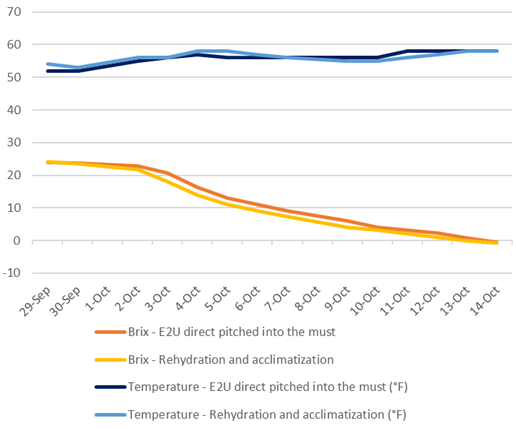
Fermentation kinetics and temperature (ºF)
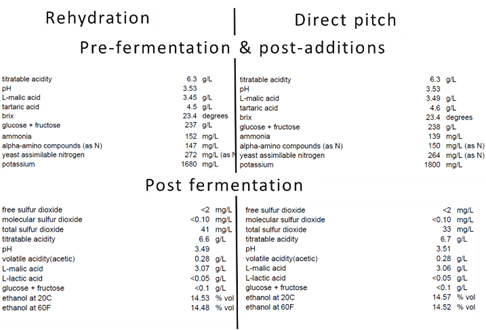
Musts and Wines analysis for each inoculation modality
Results:
The must analysis shows the two tanks were very similar in composition for the major parameters (G/F, TA, PH, YAN). The fermentation kinetics show that if you can see a slight difference between the two tanks, overall, the lag phase and fermentation speed were very similar and what to expect from this strain at this pH/temperature. The fermentations were assessed finished within the same day. The wines analysis display very similar results for the key parameters illustrating same yeast behaviour and vitality (FSO2, TSO2, TA, pH, VA, Malic acid, Ethanol).
Conclusions:
Overall, the fermentations and wines can be judged as similar in performances and analysis whatever the mode of inoculation chosen. This illustrates that not only the yeast implanted well but the yeast behaved with similar behaviour.√ EQUIVALENT ORGANOLEPTIC PROFILE AND QUALITY OF WINES IN ALL CASES
In order to assess the quality of the two wines produced they were sent for analysis to:- UC Davis for the analysis of 13 key aromatic volatiles compounds through GC-MS. The molecules analyzed in triplicate are key aromatic metabolites of the yeasts or molecules that yeast can influence the concentration of: acetate esters (ex: Isoamy acetate and 2-Phenylethyl acetate), ethyl esters (ex: Ethyl hexanoate, octanoate, decanoate), higher alcohols (ex: 2-Phenylethyl ethanol), C-13 Norisoprenoids (Ex: β-Damascenone, β-Ionone)
- Applied Sensory, LLC for a triangular tasting of the 2 wines with a professional panel.
The triangle test is a discriminative method used in sensory science to gauge if an overall difference is present between two products or to determine whether a treatment has significantly changed a product. Experienced judges evaluate products in a controlled environment to determine if perceptible and statistically significant differences exist between them. Eight wine panelists were used as judges. All judges evaluated three sets of triangle tests for a total of 24.Results for aromatic compound analysis :
Aromatic compounds analysis results:
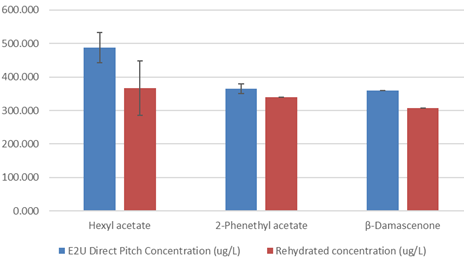
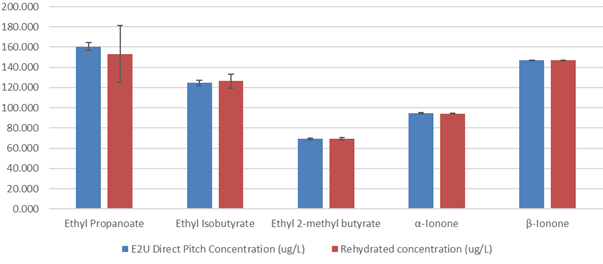
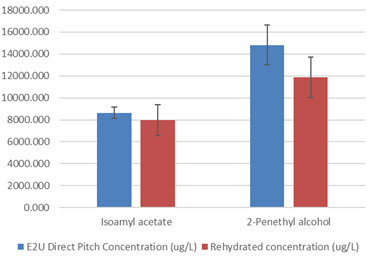
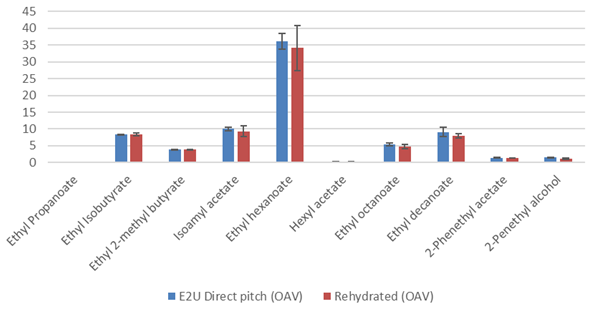
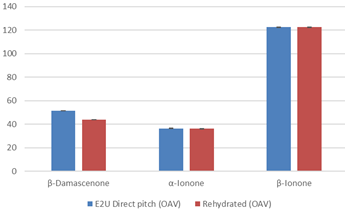
The below table and graphs presents the data in concentration and Odor Active Value for the 13 compounds analyzed along with the standard deviation for the analyis ran in triplicate. The analysis shows that there is a trend of the E2U direct pitch scenario produced more aromatic compounds but it is not significant when taking in consideration the standard deviation for most compounds. Out of the 13 molecules analyzed only the 2 phenyl ethyl acetate and the β-Damascenone are significantly different, positivively toward the E2U direct pitch wine. When we take into consideration the threshold perception, the 2 phenyl ethyl acetate is just at the threshold of perception and probably does not affect the aromatic profile very much. The β-Damascenone is the only molecule that is significantly higher for the E2U direct pitch scenario and clearly above threshold of perception that could affect the wine aromatic perception as aroma enhancer.
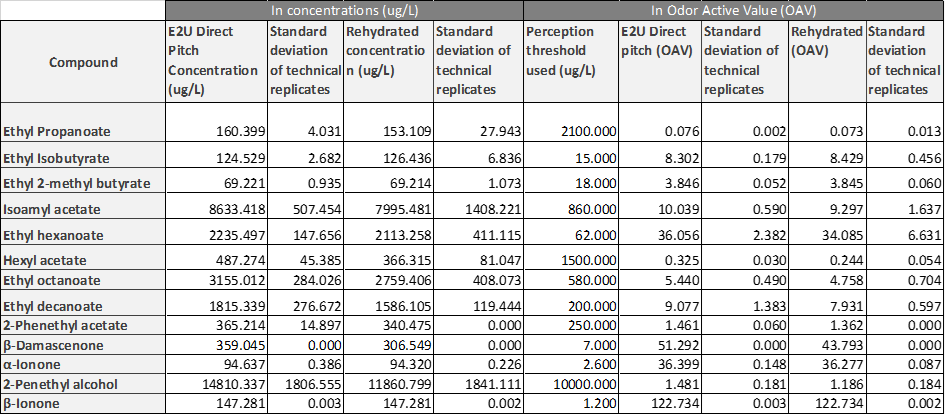
13 key aromatic compounds in both wines in concentrations
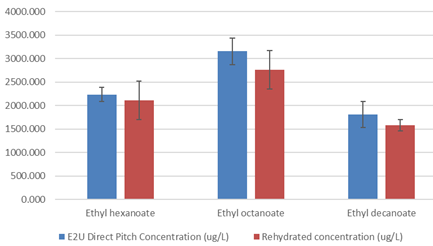
13 key aromatic compounds in both wines in Odor Active Value
Results from triangular tasting:
There were 8 “correct” answers (panelist chose the wine which was different from the other two) out of 24 – 57.6% of the time these results could have been obtained by chance alone. At the 0.1% level of significance, the wines were not perceived to be significantly different. That is, the wines were perceived to be the same or there was no perceived sensory difference between the two wines.
General conclusions:
This extensive trial on Chardonnay at large scale showed that direct pitching of E2UTM SafOenoTM GV S107 vs rehydration and acclimatization did not affect the yeast ability to implant well in the must, its fermentation kinetics, the wine analysis nor the wine aromatic molecules to a significant amount. This was confirmed by a panel of taster who judged the wines as non significantly different showing the yeast did not lose its vitality nor ability to produce aromatic compounds when direct pitched.
Winemaker’s testimonial:
‘We have used the E2UTM formulation of SafŒnoTM GV S107 yeast in our Chardonnay program for the past two years now. We love how it highlights the citrus and tropical characteristics of the fruit. We ferment at cold temperatures and the yeast could literally not be easier to use!'



Loading comments...