

The following is an excerpt from our latest blogpost on frost protection. Read the whole article here.
Frost season was particularly brutal up and down the West Coast this year. With continued early springs brought on by climate change, this may be something we need to get used to.
Two kettles of fish
Radiation Frost
This is what we’re used to seeing in California. Low-lying areas are where cool air pools. As you move up the slope the temperature starts to rise. This is called the “inversion” because it’s an inverted relationship to the one you normally see where the higher you go up in the mountains say, the colder it gets. A strong inversion, or a rapid increase in temperature as you go up, is actually better because it makes frost fans more effective.
Advection Frost
Advection frosts are considerably worse than radiation frosts since they are usually caused by a cold dry wind. Frost fans are useless since the air is just as cold high up as at canopy level. While these events are rare in California’s wine regions, we did see some of this damage this year. The best defense in these cases are sprinklers, but in general they are much harder to protect against.
Sprinklers and the importance of dew point
When water melts or evaporates, it lowers the temperature. This is why you feel cold getting out of the shower or how the canopy of your vines feels nice and cool. Breaking the bonds that hold water molecules together requires energy. When the opposite happens, i.e. water condensing or freezing, the opposite happens. Latent heat is converted into sensible heat (what you measure with a thermometer).
It may seem rather counterintuitive to actively freeze your vines to keep them from getting frost damage, but essentially that energy produced by freezing water is what is keeping those fresh little shoots and leaves safe. But temperature isn’t the only factor to take into consideration.
Dew point is the temperature at which water in the atmosphere condenses and creates dew. At that moment the same amount of water is condensing as it is evaporating. Dew point is a factor of temperature and humidity. It takes less water to saturate cold air than it does hot air.
The art of using sprinklers for frost protection
In order to accurately protect against frost, you need to start using your sprinklers before you reach the critical temperature that causes damage. But how far ahead of the game do you have to be? It’s not like water is scarce of anything…
Below is a table that outlines when to turn on your sprinklers taking dew point into account. Pick a Wet bulb temperature that corresponds to the critical temperature at which you want protection for your vines, say 32° (or lower if you’re protecting against winter kill). Then select your dew point. Where those two fields meet is the temperature at which you want to start your sprinklers.
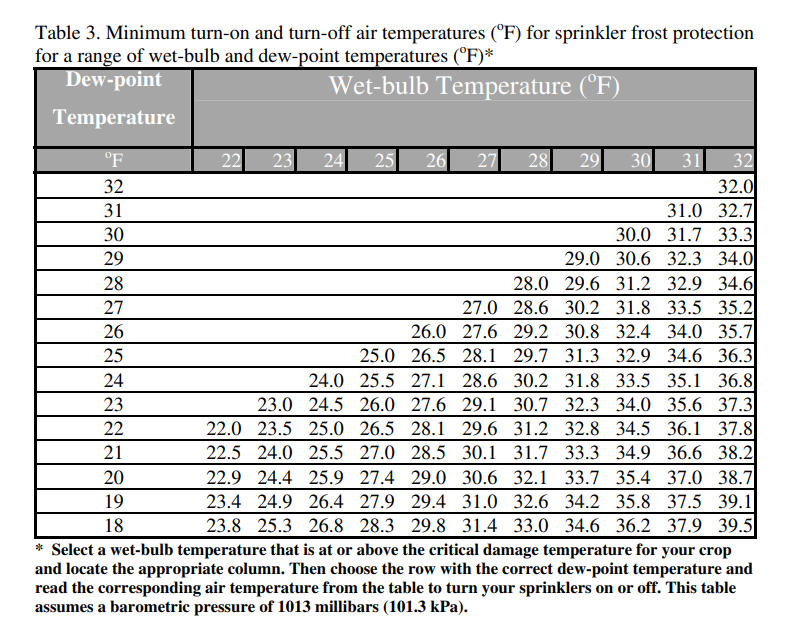 Use dew point to determine what temperature you should start your sprinklers. Table from Snyder et al. 2000.
The amount of water you apply matters
The goal of rotating sprinklers is for water to hit plant tissue, freeze (temperature goes up), and then get hit with another blast of water before it has a chance to evaporate (temperature goes down). Generally, you want the rotation rate to be at most 60 seconds. The shorter the better.
This table takes wind into consideration as well.
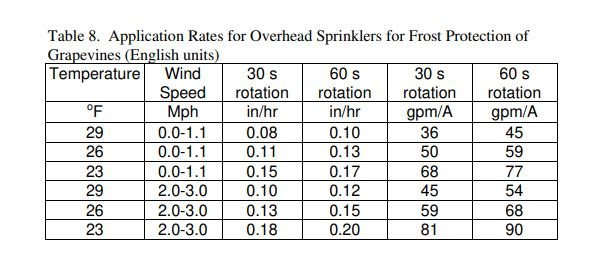 What should your output be adjusted for wind? Table from Snyder et al. 2000.
Check out the rest of the article here.
Precise Irrigation with Valve Automation
Water is precious. Labor is expensive. So why do you still have one guy running around opening and closing valves? One block gets too much, the other too little, one block accidentally had the valve left open for three days and drained half your pond.
Farming is fun, isn't it?
Why not improve your irrigation practices with automating your valves this year? Then you can schedule exactly how long you want each irrigation. Feedback sensors will let you know it all went to plan.
Automation can be integrated into soil moisture probes, well/pond monitoring, and weather stations. Contact loni@advancedvit.com to discuss the best system for your vineyard.



Loading comments...