

Each grape has its own intrinsic phenolic potential (anthocyanins, tannins) that determines the color and structure of the future red wine. This phenolic potential depends on different factors such as varietal, grape growing conditions, fruit’s maturity, and health conditions. Anthocyanins, responsible of red wine color, are small, water-soluble, and easily extracted. They are highly unstable and able to react fast with other wine compounds resulting in loss of color. Tannins, essential in stabilizing anthocyanins, are typically ethanol-soluble, and so are extracted later in the fermentation. The smallest tannins can be extracted easily, while larger tannins require physical breakage of berry skin cells to allow diffusion into must. Likewise, polysaccharides, which also have a role to play in color stability, get extracted with ethanol formation.
In the early part of fermentation, we have abundant anthocyanins with insufficient tannins and polysaccharides to chemically stabilize color, which is why oenological tools can be very interesting to consider to prevent loss of color. Once the grapes have been harvested, the phenolic potential depends on two main areas: extraction from grape skins and preservation by protection and stabilization.
1- OPTIMIZE EXTRACTION OF SKIN COMPOUNDS
Beneficial phenolic compounds are found in the grapes’ skins, which have thick cell walls. To extract polyphenols early in the winemaking process, it is recommended to use purified maceration enzymes, such as Oenozym Crush Red. Extraction enzyme, containing pectolytic, cellulase, and hemicellulose activities to hydrolyze the thick cell walls of the skin, and facilitate the release of phenolic compounds and polysaccharides, thus improving color intensity and stability. Oenozym Crush Red is highly active and fully purified of both cinnamyl esterase (which produces substrates for volatile phenols formation by Brettanomyces) and anthocyanase (which cleaves the glucose moiety from anthocyanins, reducing color stability). Its application on grapes results in wines with higher color intensity, especially red pigments, higher concentration in skin tannins, more RGII polysaccharides, interesting for their stabilization and mouthfeel properties, and an improved filterability due to the reduction of PRAG.

Effect of Oenozym Crush Red added on grapes at 30 ml/hL
2- PROTECT GRAPE’S PHENOLIC COMPOUNDS
When grapes are crushed, unstable proteins are released and aggregate through hydrophobic reactions with tannins to flocculate and precipitate. The first tannins available to react with proteins are the skin tannins, which are the most interesting for future wine structure and mouthfeel. “Sacrificial tannins” are used to react with proteins before grape tannins, thus preventing and protecting the freshly extracted skin tannins from precipitating. “Sacrificial tannins” inhibit oxidative enzymes such as laccase and PPO and are good oxygen radicals scavengers, thus protecting grape’s phenolic compounds from oxidation. Pro Tanin R is a pro-anthocyanidin tannin, developed for application on red grapes, to scavenge oxygen radicals, inhibit oxidative enzymes, and eliminates reactive proteins, thus protecting grape polyphenols. Pro Tanin R is instantaneously soluble, simply sprinkle it on the top of the grapes at picking
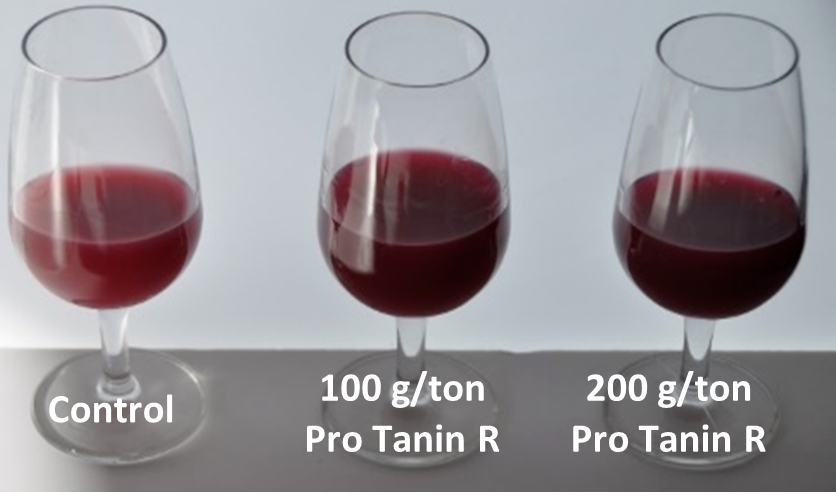
Effect of Pro Tanin R, added on grapes, on color intensity
3- STABILIZATION OF PHENOLIC POTENTIAL DURING FERMENTATION
A. WITH SPECIFIC YEAST
Even something as simple as yeast choice for the fermentation is not as straightforward as it seems when considering red wine color. Some yeasts are known to influence wine tannin levels (Holt et al, 2013), presumably through interactions with proteins on the cell wall outer. In a similar manner, some yeast strains adsorb more pigmentation in the lees than others (Morata et al, 2003), leading to different color levels in the final wine. Yeast polysaccharide production also plays a role in wine pigmentation levels (Escot et al, 2001). Excellence XR is an interesting yeast strain in this context, it is a known polysaccharide producer and good phenolic compounds extractor, resulting in wines with superior color intensity and higher IPT.
B. WITH SPECIFIC TANNINS PROMOTING CONDENSATION AND CO-PIGMENTATION
Whilst certain tannins are formulated to bind proteins, others are for different uses. Tannins used to bind anthocyanins generally contain higher levels of catechins, which are very efficient at reacting with anthocyanin due to its phloroglucinol molecular core (Bowyer, 2009) to form a color-stable dimer, long lasting color. Softan Vinification is a unique tannin rich in catechins, bounded to polysaccharides. This ‘coated’ tannin has a high chemical reactivity with anthocyanins due to the catechins fractions and softens the palate through colloidal tannin-polysaccharide hydrophobic associations.
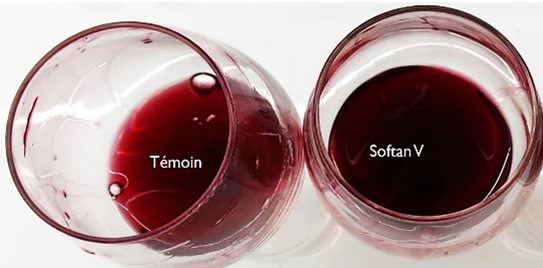
Effect of Softan Vinification, added during fermentation, at 180 g/ton, on color
C. WITH SPECIFIC MANNOPROTEINS PROMOTING CO-PIGMENTATION
Some yeast-derived fermentation products are specifically formulated to deliver elevated polysaccharide levels to the fermenting must, thus improving color stability by promoting co-pigmentation of anthocyanins. Due to the hyperchromic and bathochromic effects of co-pigmentation, the use of yeast derivates rich in mannoproteins can increase the color intensity and the purple hues.
Natur’Soft is a specific preparation of yeasts hulls, selected for their high content of mannoproteins with high affinity with anthocyanins. It is strongly effective in color stabilization, especially for high tannins content wines. Natur’Soft increases wine complexity, reduces tannins perception and aggressivity, stabilizes color, and enhances fruity characters.
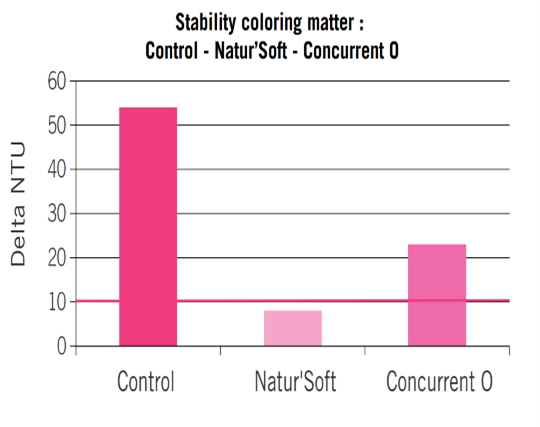
Effect of NaturSoft, added during fermentation, on color stability, compared to competitor yeast derivates
4- STABILIZATION OF COLOR DURING AGEING
The main roles of a maturation tannin are to bind in long term with anthocyanins and to stabilize wine’s redox potential. For this, different categories of tannins can be used. Hydrolysable (oak-derived) tannins are excellent in stabilizing redox potential and protecting from oxidation. Condensed (grape-derived) tannins are highly effective at binding anthocyanins. Tan’Excellence is formulated from grape and oak tannin to stabilize color matter by reacting with anthocyanins, elevate the overall tannin profile and structure of the wine and support wine redox potential. Its composition mimics a red wine’s indigenous tannin profile, which explains an elegant and soft integration in wine.
SUMMARY
Having discussed various ways in which a winemaker can seek to maximize and stabilize red wine color, following are suggested winemaking considerations. This list is not prescriptive, but simply seeks to suggest an effective management strategy
HARVEST
Limit SO2 use to minimize extraction of unwanted compounds and bleaching of freshly extracted anthocyanins.
- As alternative to SO2 for microbial protection, use Excellence B-Nature at 50g/ton. Non-Saccharomyces yeast, pure Metschnikovia pulcherrima, non-fermentative. It inhibits the development of spoilage microbes such as non-Saccharomyces, and bacteria on grapes and juice. Simply sprinkle the yeast on the top of the grapes at picking.
- Pro Tanin R, 150-200 g/ton, at picking or during fruit processing to protect from oxidation, inhibit oxidative enzymes and bind with proteins, thus protecting grape phenolic compounds. Simply sprinkle on grapes during picking or processing.
EXTRACTION - COLD SOAK /PRE-FERMETNATION STEPS
20-40 mL/ton of Oenozym Crush Red. Maceration enzyme, purified from cinnamyl esterase and anthocyanase to improve grape skin compounds extraction, help color stability and increase free-run yield.
FERMENTATION
- Excellence XR at 20 g/hL to produce powerful, structured, and elegant aromatic profile with smooth structure, intense, and stable color.
- Add 150-180 g/ton of Softan Vinification to bind anthocyanins, stabilize color, and balance mouthfeel.
- Add 150-180 g/ton of Natur’Soft to increase wine complexity, reduce tannins perception, stabilize color, increase color intensity, and enhance fruity characters.
AGEING POST PRESSING - POST MLF
Delay SO2 addition to promote color stabilization and reduce the bleaching effect of SO2.
- Add 4 g/hL of KillBrett pure chitosan to eliminate potential spoilage microbes and prevent from contamination.
- Add Tan’Excellence at 5-15 g/hL to maintain redox potential of the wine, support wine ageing potential and structure, and stabilize color in long term.



Loading comments...