

Ten years of data show execution, not traffic, is the defining factor in DTC success
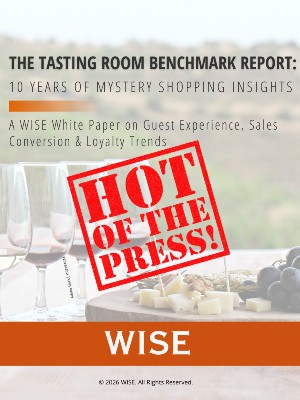 As wineries navigate softer tasting room traffic, rising costs, and heightened pressure on Direct-to-Consumer performance, a new white paper from WISE underscores a critical industry truth: sustainable DTC growth is driven less by volume and more by consistent execution inside the tasting room.
The report, The Tasting Room Benchmark Report: 10 Years of Mystery Shopping Insights, draws on more than a decade of WISE Mystery Shopping data, analyzing 6,000+ real guest experiences across U.S. regions, winery sizes, and business models. The findings point to a persistent gap between strong hospitality and the behaviors that most directly influence revenue, loyalty, and lifetime value.
WISE Mystery Shopping evaluates tasting room performance using a consistent, behavior-based framework that measures both hospitality and sales skills across more than 80 observable criteria. These insights roll up into overall guest satisfaction and three actions proven to drive results: asking for the sale, presenting the wine club with relevance, and capturing guest contact data. Collectively known as the WISE Triple Score, these behaviors represent the measurable link between hospitality and long-term DTC success. While most teams excel at creating welcoming experiences, the data shows these high-impact actions are often uneven or overlooked.
“Mystery shopping has evolved significantly over the past decade,” said Jennifer Warrington, Partner at WISE and Operations Manager for the Mystery Shopping initiative since its inception in 2012. “What began as a simple feedback tool has become one of the most effective ways for wineries to understand how their training, culture, and leadership show up in real guest interactions. The most successful wineries use this data not to critique their teams, but to coach them.”
According to the white paper, wineries that treat mystery shopping as a development and accountability tool, rather than a compliance exercise, see measurable improvements in average order value, club sign-ups, close rates, and post-visit engagement. The most consistent gains occur when results are shared transparently with teams and paired with ongoing coaching.
The research also reinforces a key industry insight: guest satisfaction alone does not guarantee financial performance. The wineries that outperform, even in challenging conditions, are those that intentionally connect hospitality to sales behaviors and follow-up, embedding these practices into daily operations rather than relying on individual talent or intuition.
“Winery metrics tell you what is happening, but mystery shopping helps explain why. This data gives leaders a shared language,” Warrington added. “It helps managers move from instinct to insight, and from anecdotal feedback to actionable coaching. It helps keep teams focused on continuous improvement.”
The full white paper outlines foundational hospitality behaviors, tactical execution strategies, and benchmarking insights drawn from a decade of real-world observations, offering winery leaders a clear framework for turning everyday guest interactions into long-term business results.
The white paper is available at wineindustrysaleseducation.com.


Loading comments...