

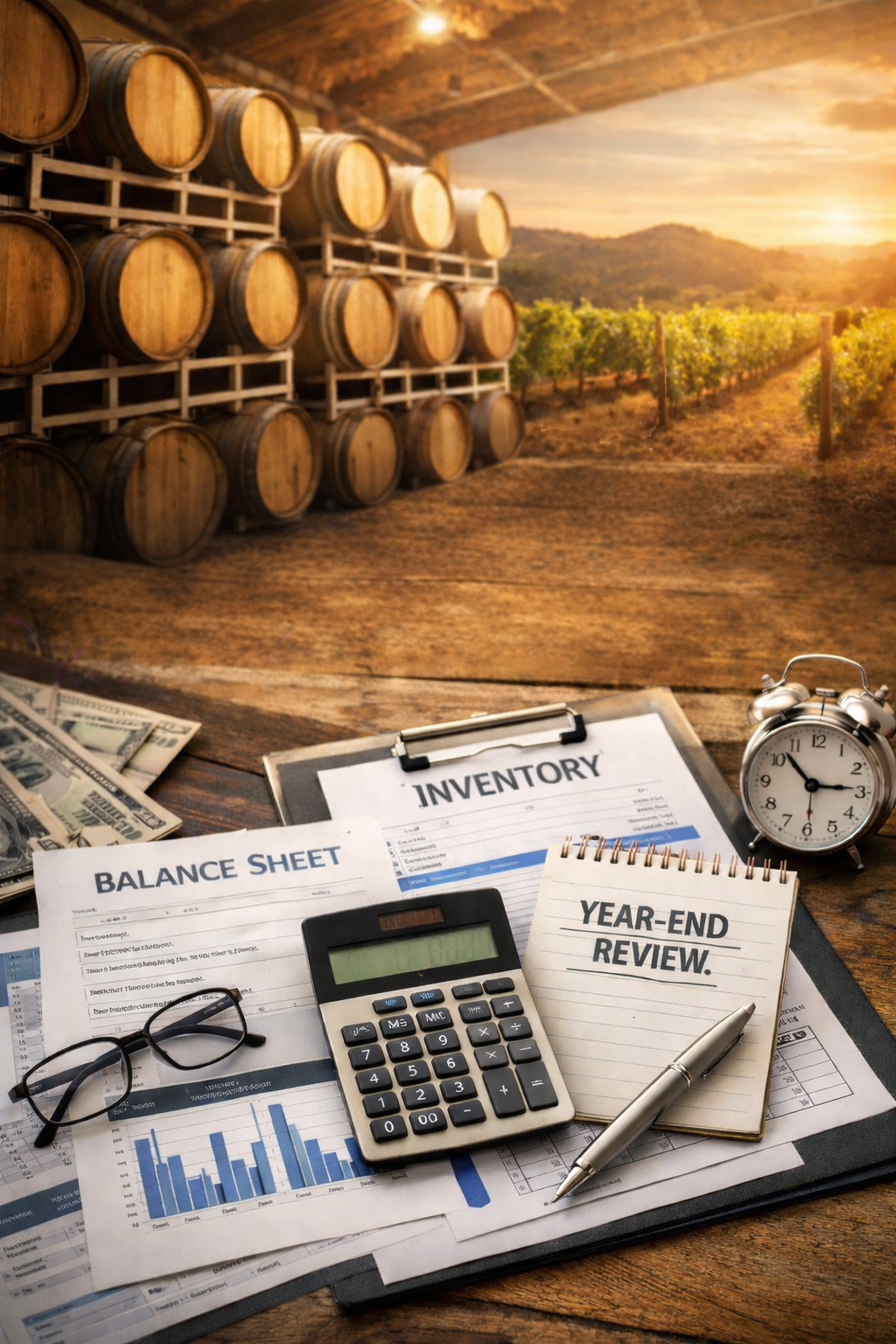
 For wineries, year-end is not simply an accounting exercise. It is the point at which financial discipline either shows up or years of small compromises finally catch up.
Too many wineries treat year-end close as a compliance task: get the books to the tax preparer, have them file the returns, move on. That mindset is increasingly risky, given that you are operating in a challenging market. Margins are under pressure, inventory is expensive to carry, cash flow is tight, and lenders and partners expect better visibility than ever before.
A clean, accurate year-end close is no longer optional. It is the foundation for survival and strategic decision-making in today’s wine market.
Start Where Most Problems Begin: The Balance Sheet
If your balance sheet is not clean, nothing else matters.
At year-end, every winery should have:
Fully reconciled bank and credit card accounts
A realistic assessment of accounts receivable (what will actually be collected)
Accounts payable that reflect true obligations, not duplicates or stale items
Loans properly split between principal and interest
This is not busywork. An unreconciled balance sheet produces misleading margins, distorted cash flow, and false confidence. We routinely see wineries making pricing, staffing, and inventory decisions based on inaccurate data.
Inventory: The Biggest Asset—and the Biggest Risk
For most wineries, inventory is the single largest line item on the balance sheet. It is also the most common source of financial misstatement.
A proper year-end inventory process includes:
A physical inventory count
Reconciliation to the production and accounting systems
Identification of obsolete, unsellable, or slow-moving inventory
Correct capitalization of production costs
If not done correctly, this is when the risk comes in. When inventory is misstated, margins are misstated as well. When margins are incorrect, pricing and sales strategies fail because it is nearly impossible to make sound decisions. This is where many wineries unknowingly erode profitability year after year.
Fixed Assets and Depreciation
It is crucial that capital improvements, equipment purchases, and vineyard investments are accurately accounted for.
At year-end, wineries should review:
Whether large expenditures were capitalized or expensed appropriately
Whether new assets were added correctly
Whether retired or sold, assets were removed
Whether depreciation was processed correctly
Accurate asset records provide a cleaner balance sheet and a cleaner profit and loss statement, which gives you clearer insight into your performance in 2025.
Payroll, Compliance, and Sales Tax Exposure
Payroll errors, missing W-9s, incorrect bonuses, and overlooked sales tax nexus issues often surface in January, by which time it is already too late.
For wineries selling direct-to-consumer across state lines, sales tax exposure is a growing risk. Year-end is the time to assess your nexus, registration, and system configuration.
Ignoring this does not make it go away. It compounds.
Why Most Wineries Should Not Do This Alone
Here is the hard truth: year-end financial cleanup for a winery is not generic bookkeeping. If it is not done correctly, it can lead to poor decisions and potentially incorrect tax returns. Both can cost your business significantly.
Year-end close is easier when you have strong accounting all year round, especially when an accountant works with industry-specific knowledge of inventory costing, compliance, production workflows, and financial reporting.
This is exactly where specialized outsourced accounting adds value.
At Protea Financial, we work exclusively with wineries and beverage businesses. We handle all your accounting, including the year-end close, inventory reconciliation, cost accounting, compliance coordination, and reporting, so winery owners can stop guessing and start operating with clarity.
If your goal is to “get through” year-end, there are cheaper options, or you can go it alone.
If your goal is to protect margins, improve cash flow, and make better decisions in a challenging market, specialization matters.
For a more detailed checklist, you can reference Protea Financial’s Ultimate Year-End Financial Checklist for Wineries and Small Businesses. But if you want the work done correctly—not just read about—this is the moment to bring in experts who live in your industry.



Loading comments...