


It’s no secret that people are drinking less.
The consistent, downward trends in alcohol consumption are presenting significant challenges to the wine industry, which is already having to operate in a complex, competitive marketplace.
In order to dissect what is happening in the world of wine and figure out how to make adjustments, industry leaders need solid information on which to base their current business practices and future projections.
Fortunately, the industry has Terrain, a group of experts providing exclusive insights and forecasting to customers of American AgCredit and other participating Farm Credit associations in order to promote a more vigorous agricultural economy.
Chris Bitter, Ph.D., a senior wine and grape analyst with Terrain and American AgCredit, has recently written two comprehensive articles for "Winescape", a publication that delves into current wine sales data and explores what those show about trending topics such as overall alcohol consumption.
We spoke to Bitter about his work that, importantly, identifies significant opportunities for wine to reclaim market share.
| Q: | What have you learned through your research about current trends in U.S. alcohol consumption, particularly for wine? |
Trends
Retail wine sales fell across all price segments in the first half of 2025. Direct-to-consumer sales, while still down, firmed up a bit over the summer, but exports deteriorated markedly in the second quarter as shipments to Canada collapsed. Sluggish economic growth, sticky inflation and a softening labor market are the most likely scenarios in the near term, which will not help the wine industry. Unfortunately, I’m not expecting much improvement in the near term.
| Q: | You’ve identified five primary structural causes for the decline in consumer preferences for alcohol. Could you discuss them? Why are people drinking less? |
The five primary structural factors are demographics, cannabis, GLP-1 class drugs, less in-person socializing, and changing attitudes toward alcohol and health.
Demographics
The U.S. population is both aging and becoming more diverse. This is a problem for alcohol because consumption typically declines later in life and multicultural consumers drink substantially less than their non-Hispanic white counterparts. The move towards moderation or abstinence is highest among younger generations, particularly Gen Z and, to a lesser extent, millennials. We’ve noted that the current decline in alcohol use has been more pronounced for men than women and for non-Hispanic whites.
Cannabis
Cannabis is now fully legal in 24 states and the District of Columbia, and marijuana use has surged since 2012, when Colorado and Washington first legalized cannabis as a recreational substance. In addition, THC-infused drinks have skyrocketed in popularity, with low-dose hemp-based versions even being sold in some states where cannabis is illegal due to a loophole in the 2018 farm bill. Research is still inconclusive; however, cannabis likely has been stealing some recreational and social occasions from alcohol.
GLP-1 class drugs
Drugs such as Ozempic, Mounjaro and Wegovy, which help regulate blood sugar and appetite, also reduce desire for alcohol. Studies show that people taking the medications have reduced their drinking, with one finding a reduction of 70%. Although a relatively small percentage of the population is on the drugs now, 35% of adults expressed interest in a recent PwC survey, and drugmakers are beginning to reduce prices, making adoption almost certain to surge in the years ahead.
Less in-person socializing
Americans are spending progressively less time socializing in person, in both their personal and professional lives. A recent study shows that leisure time spent socializing fell by 20% from 2014 to 2022, while time spent on social media and in front of screens rose sharply. Given that alcohol has long been associated with social gatherings, it makes sense that less in-person socializing is reducing the number of potential drinking occasions.
Changing attitudes toward alcohol and health
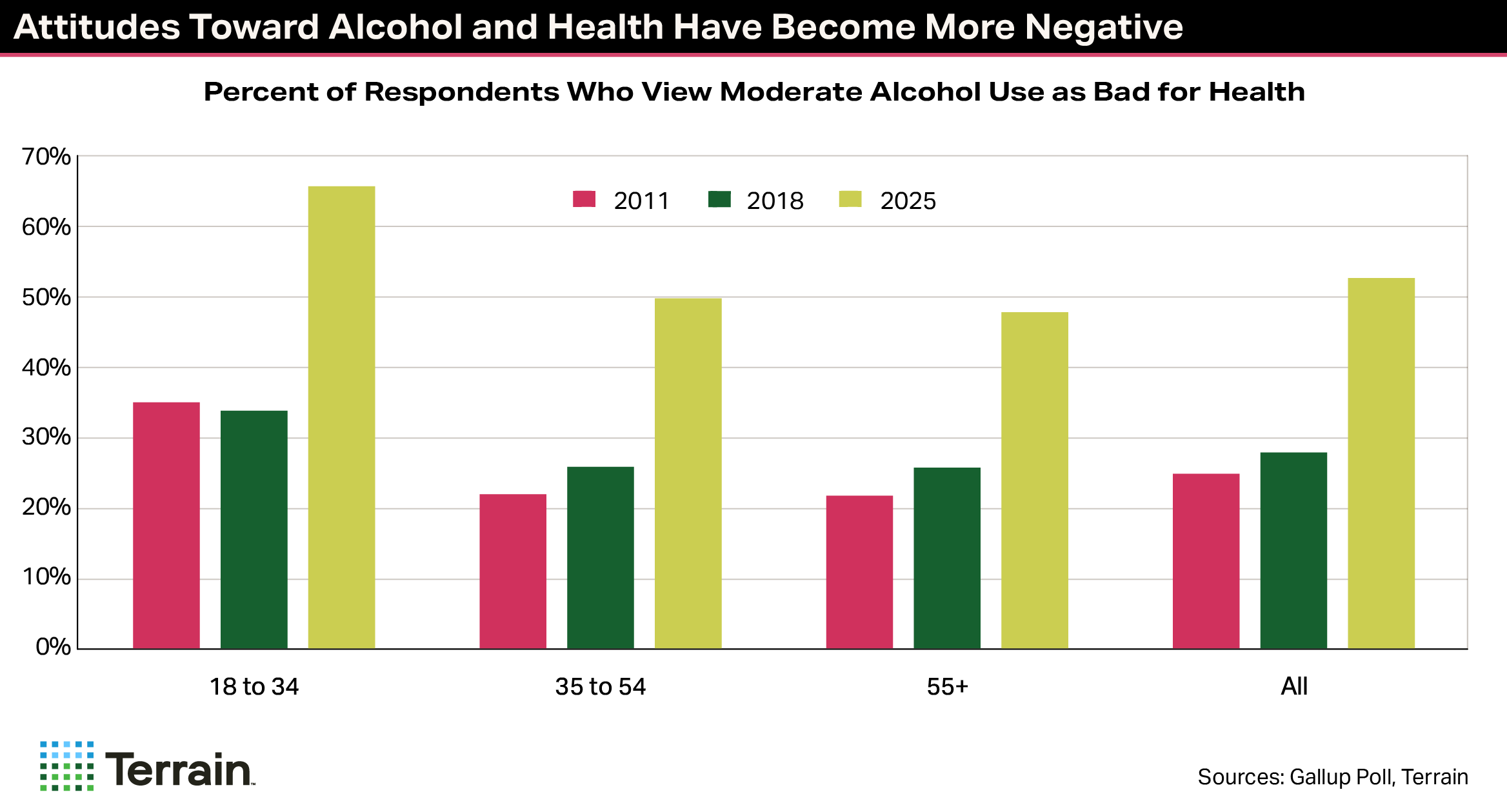
A Gallup poll conducted in 2018 found that 28% of respondents said that moderate drinking is bad for your health. In 2025, that number rose to 53%. Rising health skepticism has almost certainly weighed on alcohol consumption in recent years. A sophisticated and well-funded anti-alcohol movement that has gained influence over the last decade has accelerated the swing. That movement will continue to exert its influence on public opinion and policy going forward.
| Q: | Given these data and trends, what are some takeaways for the wine industry in terms of opportunities? |
Some opportunities involve premiumization, wine styles and packaging formats.
Premiumization
If consumers drink less, they are apt to treat it like an indulgence and consume higher- quality beverages when they do drink. Presumably, they will also be able to spend more, as they are purchasing fewer bottles, so the premium and luxury segments of the industry should be less impacted. It will be essential to maintain quality.
Wine styles
If consumers are more concerned with health and wellness or taking GLP-1 drugs, lighter, crisper wines with less oak, alcohol and calories may be more appealing. This has implications for both winemaking and grape-growing practices.
Packaging formats
If consumers are drinking alone or less due to age, health concerns or GLP-1 drugs, the 750ml bottle may not be suitable on as many occasions. There may be a shift toward smaller formats (splits, cans, etc.) and containers that preserve freshness for longer periods of time (such as bag-in-a-box wine).
| Q: | What are some of the advantages wine has over other alcoholic beverages? |
I believe wine is well-positioned to attract consumers, especially those concerned with health and wellness, as it has some distinct advantages over other alcoholic beverages.
It is a natural product with no fat, generally no added sugar, and dry wines are relatively low in carbs and calories. Moreover, the antioxidants in wine, particularly red, are thought to promote heart health when consumed in moderation.
Wine is also steeped in history, culture and geography. It is a beverage meant to be savored and shared with family and friends. In essence, it is the drink of moderation.
These virtues should appeal to consumers of all ages. The industry must strive to tell the story of wine in a simpler and more compelling manner.

For more information, on Chris Bitter, Terrain and American AgCredit, go to: https://www.terrainag.com



Loading comments...