

The packaging supply chain is sending mixed signals this month – not quite cause for alarm, but enough yellow lights to keep procurement teams on their toes.
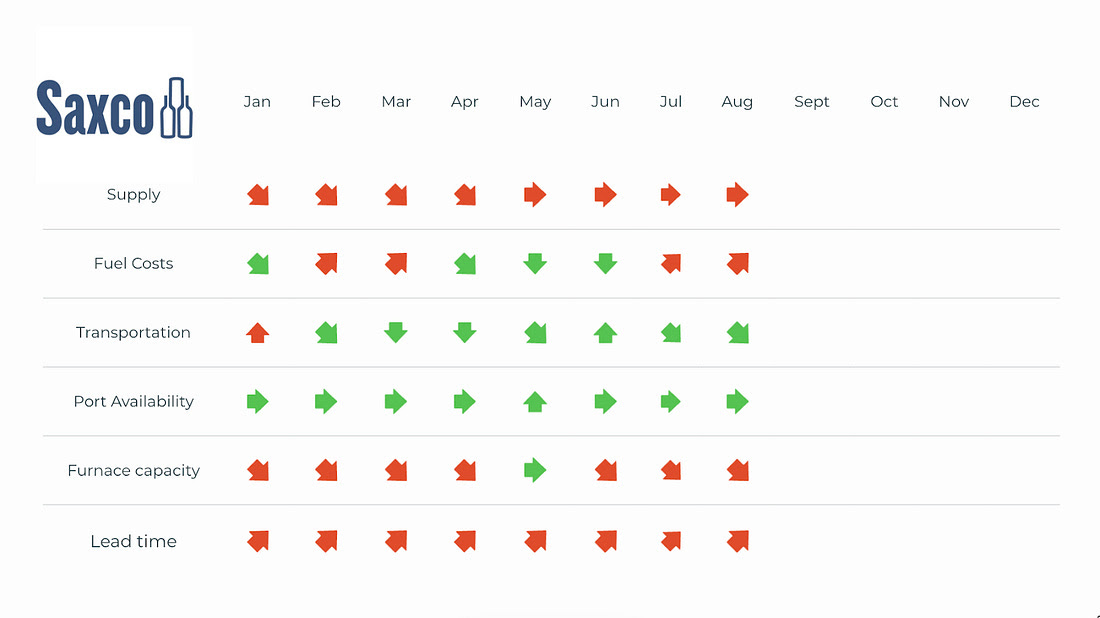
Let’s start with the good news: fuel costs edged down from July's $3.779 to $3.744 per gallon in August. But before we celebrate, some context is needed. At $3.74+, we're still hovering near the year’s second-highest diesel levels. Think of it as taking your foot slightly off the accelerator while still speeding – technically slowing down, but hardly cruising speed. Fuel remains a critical watch point as we head into Q4 planning cycles.
Transportation continues to be our bright spot. For the second straight month, we're seeing no peak season surcharges – a welcome relief that’s providing both cost predictability and operational flexibility at a time when the industry needs both.
Port operations remain stable with no meaningful congestion on key inbound lanes. The anticipated summer import surge never materialized into the bottlenecks many feared, keeping goods flowing smoothly through our major gateways.
The glass situation, however, tells a different story. The OI Portland closure continues to cast a long shadow over domestic production capacity. With no new furnaces coming online to compensate, we are seeing increasingly concentrated demand pressure on remaining facilities, particularly in California and the Upper Midwest. This structural capacity gap is not going away anytime soon.
Lead times crept up again – a trend that’s becoming concerning as we approach harvest season and holiday production windows. It feels like the days of JIT (Just-In-Time) inventory are a fever dream of the past and are not clever ways to operate, definitely in today’s environment.
Consumer sentiment: A study in contradictions
Deloitte’s latest State of the US Consumer report reveals a fascinating paradox. American consumers are simultaneously anxious about their finances and determined to maintain their lifestyle – particularly when it comes to experiences and affordable luxuries. They’re tightening belts with one hand while reaching for premium products with the other.
For packaging strategists, this schizophrenic spending pattern creates the need for a newfound agility. It’s hard to predict demand when it can easily pivot sharply, especially for packaging that serves premium segments or special occasions. The consumer who skips the restaurant meal might still splurge on the premium bottle for home consumption.
The Bottom Line
We are operating in a market that looks stable on the surface – but is quietly fragile underneath. Fuel prices remain stubbornly high, domestic glass capacity is under pressure, and shifting consumer behavior means surprises are always on the table.
The supply environment may read as “narrowly neutral,” but that equilibrium is precarious. The smartest operators are building in flexibility now – because in a market like this, neutral can turn negative faster than you can say “supply chain disruption.”

Bottled Tidbits – Glass that can stop a bullet but shatters at a touch
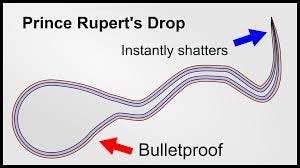
In the strange world of glass, few phenomena are as baffling, or as beautiful, as Prince Rupert’s Drops. These tadpole-shaped beads of glass have puzzled scientists for over 400 years. Strike the bulbous head with a hammer or even a bullet, and they hold firm and can withstand forces up to 664,300 Newtons (nearly 67,740 kilograms). But tap the fragile tail with your fingertip, and the entire structure explodes into dust at almost the speed of sound.
They are formed by dripping molten glass into cold water. The outer shell cools rapidly and locks in extreme compressive forces – up to 700 megapascals, nearly 7,000 times atmospheric pressure. Meanwhile, the core remains under intense tension. This opposing force profile makes the exterior strong as steel, but the interior a ticking time bomb. Snap the tail, and cracks race inward at 1,900 meters per second (4,200+ mph), obliterating the drop in a violent instant.
Prince Rupert of the Rhine brought them to England’s King Charles II in 1660 as a scientific novelty; these “Dutch tears” would remain a mystery for centuries. It was not until 2017 that modern imaging revealed the actual mechanics behind their paradoxical strength – and fragility.
Prince Rupert’s gift to the king wasn’t just a conversation starter – it was accidentally the key to modern tempered glass. Those same internal stresses that made courtiers gasp in amazement now protect every skyscraper window and phone screen on the planet. It’s always amazing to find that the origins of some of the greatest modern materials were just accidental discoveries.



Loading comments...