

Price-sensitive consumers have kept a lid on wine sales this year, while grape sales are likely to remain slow. As for the moderation movement, a range of factors are contributing.
It was a disappointing first half of the year for U.S. wine sales as a shaky economic backdrop quashed the signs of progress that were evident in late 2024. Nonetheless, there has been modest improvement in some areas since spring.
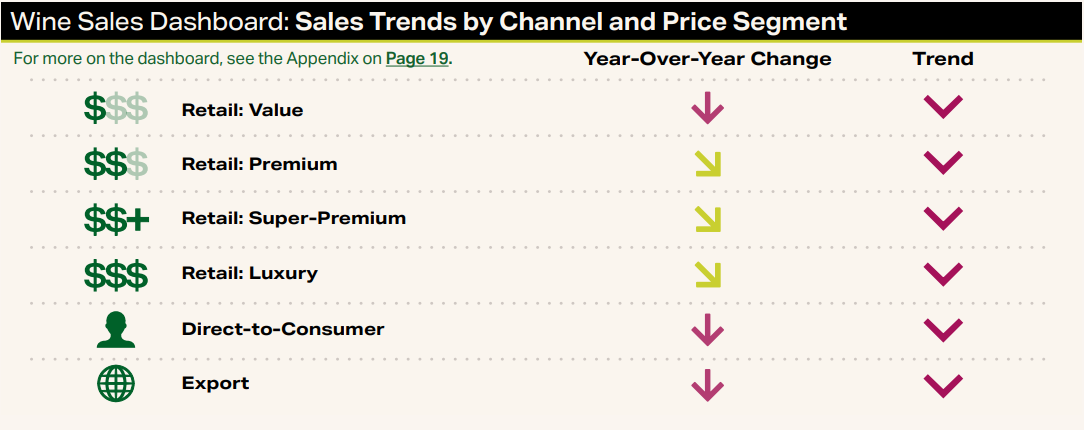
Retail wine sales fell across price segments in the first half but declined at a slower pace in the second quarter than in the first (see Page 3). Following a bleak first five months of 2025, direct-to-consumer sales, while still down, firmed in June and July. Alternatively, exports deteriorated markedly in the second quarter as shipments to Canada collapsed.
Unfortunately, I am not expecting much improvement in the near term.
The economic outlook remains murky, but the Terrain team believes that slow economic growth, a gradually eroding labor market, and sticky inflation are the most likely scenario. Consumers are apt to remain gloomy and price-sensitive.
The California grape crop looks healthy, though perhaps a bit light at this point. Grape sales remain painfully slow, and I don’t expect a resurgence before the harvest concludes. Fruit will almost certainly be left hanging again this year.
This issue’s Trending Topic focuses on the causes of the recent decline in alcohol consumption (see Page 8). Transitory influences, including a post-pandemic hangover and economic pressures, are playing a role, but structural factors appear to be the root cause.
These include demographics, competition with cannabis, GLP-1 drugs, health concerns, and less socializing in person. None of these headwinds are likely to dissipate soon, so I expect consumption to decline for the foreseeable future.
It is impossible to predict the magnitude of the drop, but it could be more pronounced than during the last drinking recession (1980 to 1995) simply because the adult population is growing at a much slower rate.
The moderation movement is an obvious challenge for the wine industry. Wine will need to take market share just to hold sales volumes steady. I believe it has some advantages over other alcoholic beverages in the battle for drinkers, but it must tell a more compelling story.
The premium and luxury segments look better positioned with respect to the moderation trend, and I expect the shift in consumer preferences toward lighter, lower-alcohol wines to continue. This has implications for both wine making and grape growing practices. Finally, consumers are apt to gravitate toward smaller formats or packages that preserve freshness for longer.
This issue:
• Identifies the root causes of declining alcohol consumption
• Shares a lackluster market update for the first half of 2025
• Presents opportunities related to shifting consumer preferences
Download the Fall 2025 Winescape



Loading comments...